Ep. 14 · Oct 19, 2026 · 56 min
Why 99.9% fidelity isn't good enough
A quantum computer that gets 999 operations right out of every thousand sounds excellent, until it has to run a million of them in a row. Arne Laucht of Diraq explains why that one error in a thousand is the whole story in quantum computing, and why Diraq is betting on the same silicon that sits in your phone.
In this episode
- What a silicon spin qubit is, and why the electron's spin beats its charge
- Why 99.9% fidelity still isn't enough when a real calculation needs millions of operations
- Physical vs. logical qubits, and why raw qubit counts are one of the most misleading numbers in quantum
- The three places quantum computing could matter (science, defense, commercial) and why cost decides which one you end up in
- Why running at one kelvin instead of millikelvin changes the economics of scaling
- What Diraq's 300 mm result with imec means, and why reproducibility beats a single record number
- Making the case to DARPA's Quantum Benchmarking Initiative, and how Diraq sizes up Intel and HRL
- The one metric Arne wants investors to watch: price per computation
Questions answered in this episode
Why isn't 99.9% fidelity good enough for a quantum computer?
Because a useful calculation needs millions of operations in a row. One error in every thousand operations compounds quickly, so error rates, not raw qubit counts, decide whether a machine can do useful work.
What is a silicon spin qubit?
A qubit encoded in the spin of a single electron held inside silicon. Diraq makes them on standard semiconductor production lines and aims to fit a million qubits on a single chip in a single cryostat, running at about one kelvin.
What should investors watch in quantum computing?
Arne Laucht's answer is price per computation: the winning machine will be the one that runs a useful algorithm at a price a business is willing to pay.
Full transcript
Transcript generated automatically from the episode audio and lightly edited; it may contain errors in names and terms.
0:01Eva Galant: Hey, my name is Eva, and this is Blond & Quantum, the podcast that breaks down quantum technology into real-world business impact. Here we make the complex simple. No equation, no overthinking, just insight, innovation, and a bit of humor. So don't worry, you don't need a PhD in physics to follow. In each episode, I talk to funders, scientists, and investors about how quantum is reshaping the industries today, not in some distant future. Oh, and if you hear a black cat purring in the background, that's my co-host. Very alive, short-haired cat joining the conversation. Her name is Moon. Let's get started. Hello everyone. Welcome in the next episode of Blond & Quantum Startup Series. Today my guest is Arne Laucht, the head of quantum measurement at Diraq, an associate professor at the University of New South Wales in Sydney. Arne, thank you so much for being here today with us.
1:06Arne Laucht: It is a pleasure to be with you.
1:08Eva Galant: I would love to start our discussion from some definitions. So a qubit needs something physical to encode quantum information, some property of matter that exists in superposition, not just zero or one, sometimes both, right? And I think most of our audience already know that if they are a regular listener from the previous talks. And different companies are using a different physical system for that purpose. So we have a superconducting circuits used by IBM and Google, and the trap ions from Quantinuum and IonQ, neutral atoms for QuEra, Pasqal, Atom Computing. Some of them were even my guests in the past. And Diraq is using silicon spin. So, Arne, please tell us a little bit more about this modality. What is silicon spin?
2:03Arne Laucht: So it's actually the spin of an electron that we're using, where the electron is hosted inside a silicon crystal. So an electron has a property which is called a spin, and that is a fundamental quantum mechanical property. It is often described as a little magnetic moment, like a compass needle that can either point in one direction or the other. And that is really the zero and the one, the quantum mechanical property that you can put into a superposition. And that property was already predicted by Paul Dirac, the namesake of our company. How long would that have been? 80, 90 years ago. So we're using that spin as our qubit, as our quantum mechanical object.
2:42Okay.
2:43Eva Galant: So the next question will be why we actually use the spin of electron as a qubit rather than the other physical properties? What are the benefits of this?
2:52Arne Laucht: Electron pretty much only has two main properties. One is the charge, and the second one is the spin. The charge is very sensitive to any form of electromagnetic noise in the environment. So that makes it very sensitive to noise and usually gives it a very short charge coherence time. There have been some companies looking into using charge qubits based on electrons, and that works to some extent, but coherence times are very short. There's some newer efforts these days where you confine the electrons on solid neon, for example, and because that is a very quiet environment, that seems to be working a bit better. But the better approach is to use the spin, because the spin doesn't naturally react to electric noise, it only reacts to magnetic influences, and the magnetic noise is much lower than the electric one. So you get coherence times. We have measured Hahn echo coherence times of up to two milliseconds in our experiments. And that is long enough with gate times of hundreds of nanoseconds to really do many operations and get good qubit fidelities.
3:57Eva Galant: I'm glad that you said that because for um for a purpose of our discussion and the next question and so on, I would love you to explain the fidelity for our non-physicist audience. Um can you explain the fidelity and also why does a 99% of a fidelity sounds good, but actually in some cases maybe a bigger problem at the scale?
4:22Arne Laucht: Yeah. So there are different fidelities that are quoted in quantum computing. And the the first one that normally people talk about is the control fidelity or gate fidelity. And that defines how well you can do a qubit gate on your qubit. And uh, if you have a qubit fidelity of 99.9%, that means you can do 999 of these gates and only get one error. So every 99 that work, you get one error, one out of a thousand. There's also two-qubit gate fidelities that tell you how well you can do your two-qubit logic operations. So for a qubit circuit, you always need to have gates that act between its qubits as well. In a classic computer, that can be a CNOT where you change the state of one bit depending on the state of the other bit. And there's an equivalent circuit in quantum computation, which is also a CNOT gate, and that allows you to entangle two qubits. That is what we define as the two-qubit fidelity. If you have 99.9% two-qubit fidelity, it means you can do 909 operations out of a thousand without producing an error. The third one is then the state preparation and measurement fidelity, because you need to initialize your qubits and you need to measure them as well, and you need to do that without an error. And all of that combined that defines your operational fidelity, and you need to be able to do operations without errors so that you can execute your calculation, your circuit. There is, of course, always the layer of quantum error correction on top of that that gets defined these days and push forward. And the idea here is that you encode the information in many qubits simultaneously and you do checks between neighboring qubits, parity checks, to see if the state has changed, if an error has kind of sneaked into your calculation. But in order for that to work, all of these checks that you do, the corrections that you do, need to perform better than a certain threshold, so that by encoding the information in many qubits and performing these checks, you actually get a net benefit. And that is what's defined as the quantum error correction threshold. So you need to be above that, and your error correction helps. If you're below that, then that overhead you get from all of these additional gate operations that you perform actually makes it worse.
7:02Eva Galant: And from my understanding, the fidelity in silicon spin is one of the highest across different modalities, right? Together with, I think, photonic and trap ions, if I'm corrected.
7:16Arne Laucht: Yeah.
7:17Eva Galant: Okay.
7:18Arne Laucht: Trapped ions have very good fidelities, but they usually have a little bit slower gate operation times. So their calculation would take a bit longer.
7:27Eva Galant: Okay. And obviously, it is so much integrated with the qubit count, uh, and that's also very important. Can you please uh explain what is the qubit count and why is the raw number of qubits sometimes one of the most misleading metrics in the industry of quantum right now?
7:45Arne Laucht: Yeah, when people talk about qubit counts, there are two different counts that one can talk about. The first one is physical qubits. So that really tells you how many of these individual quantum objects do you have in your quantum computer. In our case, how many electron spins? In the other cases, how many transmons or how many trapped ions or how many neutral atoms? But that is a bit misleading.
8:11This is hard.
8:14Arne Laucht: Because even if you have 99.9% fidelity, even if you have only one error in a thousand, you still can't do very much with that, with that quantum circuit, because a quantum circuit, a calculation that you want to perform, needs millions or trillions of quantum operations to come to a result.
8:35Eva Galant: Exactly.
8:36Arne Laucht: So if you have one error in a thousand, that doesn't get you very far. So you can't actually do much with these systems. There are some applications, and this is what we call the noisy intermediate scale quantum systems, the NISQ systems. There are some small problems that you can solve, but these are mostly toy problems and not really actually have any commercial value. Now the other type of qubit is the logical qubit. And that is what I was alluding to earlier, the quantum error corrected qubit, where you take hundred or thousand, even ten thousand physical qubits and you combine them into one logical qubit. So the logical qubit becomes the qubit that is part of your quantum circuit. And the physical qubits are just there for the error correction. They just help you to create one good logical qubit. Depending on the code that you use, like surface code is probably the most popular or the most famous quantum error correction code. You can use, as I said earlier, up to 10,000 physical qubits for logical qubit to get to an error rate that is low enough to do a circuit with a billion or trillion gate operations. There are newer codes, more modern codes, like a QLDPC code, that is the quantum low density parity check code, and that has a better ratio of physical qubits to logical qubit. With that one, you can reduce the overhead and you can yeah, maybe only need 500 or a thousand physical qubits per logical qubit.
10:11Eva Galant: Yes, thank you for explaining that. And right now, um, from my understanding, the different modalities of building quantum computer, they have a different progress on those logical qubits that are the golden grail, right? So I have read that the biggest number of proven logical qubits right now worldwide is came to QuEra with 96, if I believe correctly. But some modality, including silicon spin and I think photonic, they do not have any logical qubit yet being proven, right? And considering this aspect, how do you explain this to investors or um, I don't know, business people when they start to compare different modalities?
11:00Arne Laucht: There's a little bit of a caveat here. So some companies have started to define a logical qubit as the qubit that they use in their logical circuit. Now, have to be a bit careful. They are not not every logical qubit is a quantum error corrected qubit. Um, I'm not saying that this is the case for Q error, publication more carefully, but I know that some companies have started defining it that way, which is misleading. The other thing that I want to say is that HRL Labs has actually presented at the APS Global Physics Summit in March in Denver and followed up with the paper on the arXiv. They have actually demonstrated quantum error correction on spin qubits in silicon. So that was the first demonstration really of quantum error correction in silicon spin qubits and have shown that spin qubits can do that as well, and have to some extent caught up with the other modalities in that respect.
11:58Eva Galant: That's great. I I didn't know about it. So thank you so much for mentioning that. So if we if we think about the different modalities and um silicon spin compared to it, we know obviously that the fidelity is one of the advantage. Um scalability is by experts saying it may be discussionable. So if we if we compare with superconducting and trap iron and neutral atoms, can you can you tell us a little bit more what's ahead and what is still like behind in terms of for silicon spin specifically?
12:30Arne Laucht: So the silicon spin qubits, the field is a bit newer than the other fields. Like superconducting qubits already had qubits and and qubit circuits implemented when we started out. So we're a little bit behind that and we're still trying to catch up. But it's a long race. You do need for any proper calculation to be performed, you do need millions of physical qubits. So to have a hundred or two hundred, that doesn't get you very far. It's a long race.
13:00Eva Galant: And one of the biggest advantages can change and everything can happen still in this race. That's what you mean.
13:06Arne Laucht: Yes, and it depends a lot on scalability. So you need to have a technology where you can actually construct a quantum computer with millions of qubits. And some of the technologies where you look at the roadmaps, IBM is a good example. If you look at their roadmap, how they want to get to a million qubits is by putting a few thousand qubits in a cryostat and then putting a hundred cryostats into a big warehouse. So it's a it's a huge quantum computer, it's a huge system with an enormous cost. And that raises the question: is that system actually going to be commercially viable? For our technology, our qubits are very small, which is a little bit the challenge. They are almost too small. So we are relying on state-of-the-art tier one foundry processes to fabricate the qubits, and we need those tier one foundry processes to make them. We couldn't go to a tier two foundry, that wouldn't work. So we are limited on that aspect. But the the upside is that we can put a million qubits in a single chip. And we can put that in a single cryostat. So our system is much smaller and much more efficient to operate. I often say that there are kind of three regimes of where quantum computing could have an impact in the world. And the the first one is just as a scientific instrument. You think of it as something like the Large Hadron Collider, the LHC. You pour a billion dollars into one system and you create something that gives you a benefit for humanity and allows you to do scientific discoveries. And that is, yeah, of course, a very good thing, but it doesn't give you any commercial benefit. Second one is for like defense applications. There are applications where defense is willing to pay an order of magnitude more than what a company or the commercial market would pay for a quantum computer. That's kind of the second tier. And the third tier is really systems that are commercially viable, that can solve problems in the regime of drug discovery and the regime of optimization, and we can actually have a commercial impact.
15:18Eva Galant: And from my understanding, we are still not there yet, and we need a few more years to get to that point.
15:24Arne Laucht: What I'm heading towards is that you need to get the cost down for the system. Because if it's too expensive, you're not going to have the commercial impact. You will only have the defense impact, or you'll only have the scientific impact.
15:37Eva Galant: And having it potentially on a simple chip that can be manufactured the same way as a semiconductor sounds very sounds very attractive and cost-effective. And uh, as you said, the price will be super small. We'll come back to it because definitely there is more that I would love to ask you about your work on Diraq as well, and uh everything related to um silicon spin. But before we go there, I would love to zoom out a little bit and um focus a little bit on you and your career because I think your career is a little bit unique as well, and I think uh it would be great to discuss this as well because the audience may be interesting. So, Arne, from my understanding, you did your bachelor in physic engineering and your PhD in physics in Munich, and you were focusing on photonic crystal quantum optics. That's a long phrase, photonic crystal quantum optics. But it is a different physical system than silicon spin. So I wanted to ask you what made you private for that.
16:42Arne Laucht: Yeah, it is like the standard academic career path. You you do a PhD, you work on a specific topic, you learn a certain set of skills, and then you kind of go out to do a postdoc somewhere else. And it was always the idea that you have to do that ideally internationally, and that you have to change something. You have to either work on a different material system or use a different measurement method. The idea, I think, is very similar to what you have in traditional jobs like a baker or a shoemaker who does an apprenticeship somewhere and then goes out to learn more from other masters to increase the skill set and then comes back and becomes his own master.
17:23Eva Galant: That's a beautiful idea. But you you from my understanding, you change both because you went to Australia, right? Yes. And you change also the modality. So why actually Australia? Let's talk about it as well. Like, how did you find your way to Australia? And right now, you from my understanding, you're in Boston, leading obviously the measurement department for Diraq as a part of expansion.
17:46Arne Laucht: That's actually a bit outdated. Sorry.
17:49Eva Galant: Yes. Okay, so please tell us more.
17:53Arne Laucht: So I was head of quantum measurement at Diraq until about one and a half years ago, when I moved to the US. So my my role as head of quantum measurement was to kind of look after the laboratories, the measurement infrastructure, the equipment. For example, we build a new laboratory on UNSW campus, which is kind of our main headline laboratory now. But being on the other side of the world, it's not very easy to kind of look after these things. So I kind of stepped out of that role and was in a more flexible role, working on this and that, helping with systems engineering, working on grant applications, still doing student supervision for a while. And my role title for that duration was Technical Fellow. And uh about half a year ago, I now moved into the role of head of technical partnerships.
18:43That's fantastic. Okay.
18:45Arne Laucht: Looking after our collaborations and partnerships with other companies and uh universities.
18:51Eva Galant: Well, it's a little bit late, but congratulations. So, if you could talk about it, what kind of partnership uh are you focusing on right now? Is it the governmental partnerships, procurement, other big companies? What is it?
19:05Arne Laucht: It's not just one, it's many. So um I'm looking at I think it it's roughly 20 different partnerships and collaborations simultaneously. And it's mostly on the technical side of things. So it's it's mostly on things and aspects where we have a skill gap in the own comp in our company and where it makes sense for us to partner and collaborate with externals, universities or companies to kind of close that gap and expedite the development. And that is on the cryogenic side of things, so cryostats or thermalization, it's on measurements, it's on automation, it's also with government entities, on funding that they can bring into the company to speed up the development of a quantum computer.
19:52Eva Galant: So it's kind of across the board. Because Diraq is still a startup, but it's pretty big startup. You're definitely long way past seeds. So can you tell us a little bit more about the size of the team for reference? The team that you have in both Australia and the US?
20:09Arne Laucht: Yeah, so we have we have grown quite a bit over the last few years. We might actually push into the scale-up category now rather than the startup category. And we have now more than 100 staff in total.
20:22Eva Galant: Amazing.
20:23Arne Laucht: Plus PhD students. So we're still very tightly integrated with the university, and we still have about 20 PhD students that work on projects related to the company.
20:35Eva Galant: Well, congratulations, that's an amazing success. And uh, from my understanding, you were one of the first people in Diraq, right? And this is because of your long-term relationship with Andrew Dzurak and uh Andrea Morello, that you first work together in the University of New South Wales and then in the Diraq. So I actually would love to ask you what does this long working relationship give you? Um, that maybe, I don't know, fresh team would not offer.
21:06Arne Laucht: Yeah. So I first met Andrew about 15 years ago when I arrived in Australia from my postdoc. There was always a little bit of collaboration with his group because of the fabrication of the devices. But then I started working much more closely with him about 10 years ago when I got an academic position at UNSW myself and kind of worked with him on the quantum dots. And that kind of took me from just an academic position to like a pre-commercial phase and then into the company Diraq. I've known him for a long time, he's known me for a long time. Uh, of course, there's a lot of trust there between us, and uh, we know how to help and support each other, and that is something that it just takes time to build up there. So you wouldn't have that in a fresh team.
21:54Eva Galant: I understand. And uh obviously you're still part of the academia, you're assistant of the professor on the university. And so you still you completely did not live fully. But I wanted to ask you about the first experience. Was that a shock for you to switch after so many years being active in academia and the research field? And then, you know, move to a private company that is in a sense spin-off? I don't know if we can say that. Is this? Yeah. Okay. So is the spin-off and you know, out of sudden, you are in the private company full of investor deadline, maybe funding problem on the beginning, and so on. So can you tell us a little bit more for the potential scientists who are in the audience and thinking, should I do that? Should I join a startup instead of staying in a you know pretty safe academia position?
22:48Arne Laucht: I would say that that for us, the the change was actually a bit more gradual. So it wasn't that we we suddenly said, okay, we're making a company and we moved everyone off campus into a new lab and a new office. The University of New South Wales has a very special and specific arrangement. The way that they create spin-out companies. Essentially, it's an equity arrangement where the university has equity in the company. And in response, the company can stay on campus, can use the offices, can use the laboratories, and continue working there while building up and setting up the commercial framework for eventually separating from the university. So that has a huge advantage because you don't have a gap. You don't have a break between your previous activities and your new activities. You can just roll over and you can just continue. So essentially, what we've done is we've taken the research group and we've turned that into a company. Everyone who was part of the research group became part of the company. Every student postdoc is contributing to the company. So it was a much more gradual transition for us. And in the early days, the company did continue operating very much like a research group because that is what everyone knew. And then over the years, with getting additional staff in, with getting a bit more business-oriented staff in, things started to change, obviously. So we had a CFO that was looking after the budget. We had a bit more business-oriented mindset. We had to look after milestones for investors, as you were saying earlier. But we had to think a bit more ahead to systems engineering by planning on okay, what would actually a quantum computer with a million qubits look like? What are the individual parsing components that fit in there and how do we need to develop them and make plans for that? So it became more organized and more industrialized, maybe well-reported and more commercial.
24:50Eva Galant: And and I think Diraq is also very unique on that sense that Andrew is a CEO of the company, right? Which in many cases, the professor who's starting it, is trying to be more on the science side, and the company is looking for professional management on the company. So I think this is also very unique, and I can imagine that the research is because of it very strong part of day-to-day operation and will never be neglected through some business KPI. Is that correct?
25:25Arne Laucht: I would say that is correct, and we are in a field where we still need to do a lot of RD to get to a product. So we can't neglect the research and development part of it. For Andrew, I can say he's he's a great dealer, he's a great manager, he makes an excellent CEO. I can see that other academics that are maybe not quite as business oriented, they might benefit from having someone external taking over the business side of things and focusing on the science and the research. But Andrew is very much on his element.
26:01Eva Galant: So it seems like that the core team, including Andrew and yourself, were first focusing so much on RD and SIS, and then needed to adapt as the company grew and become um more oriented on the business. Or maybe business took more of your time. Are you missing to being um head of management and more close to what's going on in the lab?
26:25Arne Laucht: I feel like that's always a little bit the curse of a career, right? You you always kind of lose a little bit the the hands-on things and you're you're moving up into management of things where you're not really at the pulse of things as much anymore. And I think that is also the case if you're staying in academia. Not necessarily something to do with the business and commercializing things. So, yeah, of course I miss it because that's how I got into quantum and research at the beginning by doing things myself and working on these things with my own hands. But there is still a lot of research going on in the company, and it's not like we are stopped that and now just doing business. There's still physics to be solved, there's still experiments to be made, and overall it's still very much a there's a lot of science happening.
27:21Eva Galant: I see. Well, I did have a prepare a couple of questions, having in mind that you're ahead of management. So if you want, we can still try to answer them. If they're not updated anymore, maybe we can skip them. That depends on you. But I wanted to ask you about one thing. We we talked previously about fidelity and how much this is important. And I wanted to ask you like the moments when Diraq claims a fidelity number publicly, whatever the number can be, how much is credibility is a number that rests on the team that you were leading in the past, the teamwork versus the design of the qubits itself?
28:02Arne Laucht: I assume you're referring to how much is credited to team Robin?
28:06Eva Galant: Yes.
28:06Arne Laucht: Yeah.
28:07Eva Galant: Or depends on, yeah.
28:08Arne Laucht: Yeah. So the device, of course, has an impact on the fidelities that you measure. And that is because you have devices with different noise levels, different designs that work better or work worse. But to some extent, you can say, okay, a lot of that comes down to the experience and expertise of the team and the hard work that they've put into it five years or ten years ago to get to the point now. So there is also some credit to be given to the team who developed the devices in the first place. But then, yes, once you have a device in acquires that and once you've cooled it down, you still need to do a bit of tuning and calibration of the device. And uh some devices work better, some still work a bit worse. And one of our hopes is that by going to a commercial research foundry, we can reduce the variability in devices compared to what we have with devices made in a university clean room or made in a more researchy process at the foundry. So you still need to know your way around the tuning at the calibration. So it's still important for experimentalists to get it to the good operating point and then improve the fidelities through that. But that is also something that we're working on in automatizing. So at the well, at the moment, it's still a lot of manual work that goes into it. We have started developing like automated processes and workflows that can tune up a device independently and get the qubits tuned up and calibrated without human interaction. And that is something that we still need to work on for the next few years. It's not working perfectly yet, but over the next few years we should be able to get everything automatized.
29:53Eva Galant: And you have work in the previous position on verifying the Bell's inequality violations. Is that what you're mentioning right now?
30:02Arne Laucht: That was one kind of demonstration of where we were able to achieve good fidelities. The violation of Bell's inequality, which is a very foundational kind of proof that you have entanglement and you have the entanglement between two particles, that was actually just a way of demonstrating that we have good fidelities across the board. I mentioned earlier you have one qubit fidelities, two qubit fidelities, and the state preparation and measurement fidelities. And in order to be able to show a violation of Bell's inequality, all of them need to be good. One of them is bad, you can't show a violation. And so the main message of that paper was more that we are able to achieve good fidelities across all of the different metrics. And the violation of Bell's inequality was kind of the proof that we used to get there. And that was to some extent inspired by a paper by Andreas Wallraff from ETH Zurich. Because in that year they had shown the loophole free violation of Bell's inequality between two superconducting qubits that were placed in separate quiets, where they had a cryogenic link in between. And that paper had a nice little figure how much the measurement fidelity plays a role in the violation of Bell's inequality. So that was the inspiration, and then we used that to demonstrate that we can do that in spin qubits as well.
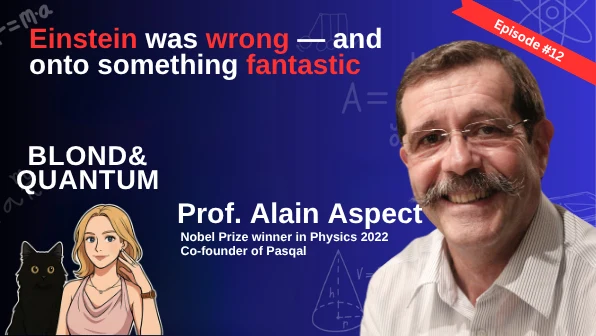
31:29Eva Galant: That's very nice. And by the way, because I didn't I just start talking about it and uh we didn't explain. But for those listeners who are unfamiliar with Bell's inequality, I will recommend and point you to my episode of the Nobel laureate, Professor Alain Aspect, who won Nobel Prize on exactly that work. So all the explanations are in the other episode. Um in the same time, Arne, in 2025, the nature result with imec showed over 99% of fidelity on a 300 millimeter industrial line. Can you first explain us what that means in simple terms? What is the 300 millimeter line? And then why does it matter actually in this handpicked lab device?
32:17Arne Laucht: So the first of all, the 300m refers to the diameter of the wafer. So when you do the processes, you take a silicon wafer and you run it through the whole machinery at a foundry to do your lithography steps, your etching steps, your deposition steps, and all of that to create your electronics. And that's the same for a computer chip and for a phone chip, as well as for smaller electronics and transistors. The industry started out with smaller wafers, but they noticed that it gets more cost-efficient by going to bigger and bigger wafers. So the industry standard these days is 300 millimeter. Any chip that you would find in a laptop or your smartphone is made on a 300mm processor. And that is why manufacturing qubits in a 300mm line is the most compatible one with the current CMOS industry. If you would do it on a smaller wafer scale, then yeah, it's it's outdated technology. It's it's not state-of-the-art. So 300 millimeter is the way to go.
33:25Eva Galant: I see. And why does the reproduction across the runs matter more, even more than uh the single best number?
33:35Arne Laucht: So for a quantum computer to work, we talked about that earlier, you have to have your gate fidelities and your qubit fidelities above a certain threshold. Otherwise, the quantum error correction doesn't give you any benefit compared to the physical qubits. And for that, all of the qubits, maybe not quite all, but most of the qubits that make up the logical qubits have to be at that fidelity. So it's not enough to have a single or two qubits at a really good fidelity. You need to have all of them at a very good fidelity to get that benefit of the quantum error correction. And that means you need tens of thousands or hundreds of thousands, even millions of qubits at that fidelity. And that's why statistics and reproducibility matters a lot. You'll find that if you look at more recent publications that are a bit more industry focused and commercially focused, that people often provide cumulative statistics. So they provide for the fidelities an exact graph of how many qubits are below any value of fidelity. So you would find that maybe 1% of the qubits is below 99%. And that matters because these ones are too bad for quantum error correction.
34:50Eva Galant: I actually read when I was preparing for our interview, I read a very interesting um comparison outside of the industry about the fidelity. It says, if you can imagine a surgeon performing um operation, right? So if we know that, hey, one time out of thousand cuts are wrong, then we will think, oh, okay, I should be safe. Until the surgeon needs to perform one million cuts, right? On the same body. Then the story is a little bit different, and that even those smallest numbers really cumulatively matters. Okay, another question, another difficult descriptions is about Diraq operating near one Kelvin rather than a deep millikelvin temperatures that most of your competitors, from what I have read, um, need. So I wanted to ask you to first explain again. Um, and then we can talk what does the one Kelvin even feels like and what hardware does it require?
35:57Arne Laucht: Okay. So um yeah, one Kelvin essentially means it's one degree Celsius above absolute zero, which is still very, very cold. It's still minus 272 point something degrees Celsius. Um millikelvin means it's a thousandths of a Kelvin above zero, absolute zero. Now most computers don't operate at one millikelvin, that's super difficult to get to. They operate at a temperature of 20 to 40 millikelvin. But it's still very low and needs a lot of effort to get there. Now, people don't want to operate at that temperature because it's difficult, it's costly, it needs a lot of energy. But if you can increase your temperature, it makes your your system cheaper and uh better energy consumption, better energy efficiency. So it's one of the big advantages that our qubits actually work at temperatures up to one Kelvin with very good fidelity. So the manuscript that you were referring to earlier with the violation of Bell's inequality, that worked up to a temperature of one Kelvin. We are, of course, losing a little bit of coherence and fidelity by going to that temperature. And that is something that we're spending a lot of time into kind of understanding how does the temperature influence coherence, times, and fidelities? And up to what temperature do we think we can operate the qubits without having too much of an impact on the quantum error correction? And it turns out there's actually a sweet spot. There's an optimal temperature. Below that temperature, you're uh paying too much for cooling, and above that temperature, you're paying too much because your qubits are getting worse and you need more qubits.
37:41Eva Galant: That's optimal. So you actually asked the the question, the next question that I was supposed to ask. Like, what did you give up on on this? Okay, that's very interesting. And then can we talk a little bit about the source of noise or uh the error that you're still fighting in those systems? So, can you tell us a little bit more if this is like pure hardware problem or is a control problem, or maybe it's a measurement problem? Where is this this the source of the problem uh right now and why it cannot be solved today versus in the next couple of years?
38:14Arne Laucht: I I would say it's mostly materials. So the the two main contributions of noise is magnetic noise from nuclear spins of residual silicon-29 isotopes inside the silicon. Some isotopes of silicon, like silicon 29, have a nuclear spin as well, and that nuclear spin, again, is similar to an electron spin, a magnetic moment. And by flipping or by changing, it creates a noise environment for the electron spin qubit. Now, in natural silicon, you have about 4.7% of silicon 29 atoms that have a spin. And we're already working, everyone in the field is working with isotopically enriched silicon 28 material. Silicon 28 does not have a nuclear spin, so it's it's much quieter. But we still have at the order of 400 to 800 parts per million of silicon 29 in these chips. So there's still silicon 29 atoms around, they're still flipping, and they're still creating noise. Now, by going to lower concentration of silicon 29, like 50 ppm or even a few ppm, you can get rid of that noise completely. And that is not necessarily a technical challenge, it's just a supply chain and cost challenge. Because to get from 100 ppm to 10 ppm, you have to run your enrichment process much longer, and that costs money. So you just need to get a hold of the source material and you can get rid of it. We don't really see that as a big bottleneck because you can just throw a little bit of money at it and the problem goes away. Also, the amount of material that you need for spin qubits is fairly small. You don't need to have a whole wafer made out of enriched material. You just need a very thin top layer of 100 nanometers or so made out of the enriched material. The second big source of noise is uh electric noise. And that comes largely from charge traps and defects in the dielectric material of the silicon structures. So normally we have have the silicon, on top of that, we have a layer of silicon oxide, that is the dielectric material, and off top of that we have our metal or in the imec process polysilicon gates that allow us to create an electrostatic potential and confine and trap these electrons to be used as qubits. And as long as there are charge traps and defects in there that can switch their charge state, you get electric noise as well. imec has done a great job already kind of improving that process in their process line, and they got charge noise values that are an order of magnitude better than what we had in our university devices beforehand. But there's still some optimization that can be done and for that noise to be improved. And so both of them are material problems, and we're kind of trying to turn both screws over the next few years to get better performance.
41:18Eva Galant: And is the optimization ever actually finishing, or is the optimization a constant thing, actually?
41:23Arne Laucht: Um at some point, like you're turning one screw and you see one noise level coming down, and then you get below another noise level, then you can stop turning that screw and you start turning this screw. At some point, we're maybe low enough that we don't have to.
41:38Eva Galant: Yeah, the design of the chips itself, I think is a very interesting topic, and we probably can cover it. It's a whole separate episode. But I wanted to ask you a little bit about manufacturing, because the whole uh Diraq pitch rests, and not only yours, everyone in uh silicon spins, rests on the using existing semiconductor fabs. And I wanted to ask you like, what's the gap between being compatible with CMOS and actually manufacture at the volume today? And you can please explain maybe CMOS as well, um, just for benefits of our audience.
42:14Arne Laucht: Yeah, so CMOS just means complementary metal oxide silicon. Just means that you have a metal gate on top of an oxide on top of a silicon layer. And you can use P-type and N-type doping to create your junctions and structures in there.
42:33Eva Galant: And that's a standard in building chips, from my understanding, right? Exactly. Exactly.
42:39Arne Laucht: Every transistor that you have in a phone or laptop is built using that process where you have a source and a drain contact in your silicon channel. You have a dielectric on top. It's not necessarily um silicon oxide anymore these days, it's hafnium oxide or some other high-K dielectric. And then you have your gate on top, which might also not be metal anymore, it can also be polysilicon or something. And with that, by applying a voltage to your gate, you can switch on your transistor or you can switch it off, and you can perform computations that way. Um, the whole industry has developed to be very, very good in creating classical transistors for making CPUs or GPUs with billions of transistors on a single chip. What we need for our qubits for the confinement of the electrons is very similar, but it's not exactly similar. So we need a few changes to the process, a few changes to the standard design rules that the foundries have to be able to accommodate making the qubits. It doesn't necessarily mean we have to reinvent the wheel. It just means we have to break a few of their standard rules and change a few of the parameters and dimensions. And standard examples. Are the the pitch of the gates? We need to get our qubits fairly close together. We need an additional gate in between to control the exchange coupling and be able to implement two-qubit logic. And we need isotopically enriched silicon 28 in the process, as I mentioned earlier, to get the magnetic noise down. That part is fairly easy. You just need to swap a bottle of silane gas from your standard one to the enriched one. But a foundry still needs to be able to accommodate that and include that in their processes. So there are a few changes to be made, but overall you can reuse, I would say, more than 99% of the standard liner and processes.
44:45Eva Galant: Once this happens, basically as a result, we can produce, or you can actually produce and manufacture a large volumes of chips at light speed almost.
44:58Yes.
45:00Eva Galant: That's great. Okay. And when that's gonna happen? Because I think I have read somewhere that Diraq is promising the first commercial product by 2029. So is that 2029 that time when we can see those chips being produced in the large scale?
45:17Arne Laucht: Um yeah, I mean we're already starting to produce chips in foundries. That's only going to accelerate over the next few years. So 2029, that is kind of meant as our first product. We're not planning on really having a product before then. We don't think it makes sense to productize devices with two or ten or even twenty qubits because you can't really do anything with it. And it's just a distraction from developing systems that can have a commercial impact. So uh 2029 is meant to be our first product with uh a chip that has a number of qubits where you can actually do quantum error correction and where you can do something meaningful with it. If everything goes well, that chip would be state of the art compared across all qubit modalities and would allow like problems of some commercial value to be solved, but it's not going to be our final product.
46:22Eva Galant: So we first have to find out that make obviously a lot of sense. Um are you feeling comfortable with that timeline? If you think it's realistic to do it.
46:32Arne Laucht: It's realistic, yeah. It is realistic, optimistic, but it is realistic.
46:37Eva Galant: It's everything in the startups. So I hope that once we once we meet in next four years, um that will be you know a launch of the product. Um Arne, I wanted to change a little bit of topic, and I wanted to ask you about your participation in DARPA quantum benchmarking initiative, because this was explicitly designed to stress test claims like Diraq. And I think what is also unique is the fact that Diraq is the Australian company that was chosen for this DARPA project. I think DARPA is not that, I don't know, I I know a couple of others components that are cooperating with DARPA, but they usually prioritize American components rather than um international ones. So I wanted to ask you what's the hardest things your team had to prove to get through the stage B.
47:28Arne Laucht: So there are there are actually quite a few international companies in in the DARPA QBI program. Other companies from Australia, from Great Britain, from France as well that are all participating. And I I guess for DARPA, for them, it is a really good way of getting knowledge about what everyone's doing. So it's not necessarily about giving money into other countries and that money disappears. It's really using that money to get all of that knowledge into the US. So for them, it is very much uh paying for the knowledge and the learnings. But yeah, the DARPA program itself, at least uh stage A and stage B, very much focused on the big picture to kind of define the concept of what a quantum computer would look like, how the different components interact, how everything works together. So maybe that's not the big patch anymore, but that is actually going into the details, but looking at everything from a systems engineering perspective, kind of really proving to them that there is no bottleneck, no physical showstopper to achieving a utility scale on a computer with that technology. And that means you really have to think about everything. You have to think about how you you put things together, how everything fits. And that was probably the most difficult part to really sit down and draw out everything and then kind of pitch that to DARPA.
49:01Eva Galant: I see. Okay. Thank you for sharing this experience. I think that can be really interesting and hopefully for other international startups that can be seeking cooperation with DARPA. And I also wanted to ask you a little bit more about your competitors landscape. Because Silicon Spin has also other players on that market, and you have some serious competitors. I'm thinking here about Quantum Motion, SQC, Intel, and so on. What's different about Diraq? Where are you guys genuinely ahead and where you may be behind for the competitors?
49:36Arne Laucht: That is a very good question, and uh I don't think a question that I can necessarily completely exhaustively answer because I don't have insights in what the other companies have developed and what they haven't. What I can say is that um maybe the APS Global Summit in Denver in March, that was a bit of an eye-opener. We had a had a great invited session with one speaker from HRL that he has led, who was reporting on their efforts and the implementation of quantum error correction on their devices using exchange-only qubits. So they had 54 core numbers, 18 exchange-only qubits, and they were able to show like a small quantum error correction code on those. So that was kind of bringing the qubits on the landscamscale of quantum error correction. The other great talk was by Ravi Pillarisetty from Intel, who was mainly focusing on their fabrication efforts. Now, Intel has their own foundry, they have a very close interaction between the quantum team and the foundry team. And Ravi was showing plans on getting devices with several thousand qubits, concrete plans and designs on how Intel can produce several thousand qubits in their foundry. And they're actually going to have chips with 729 qubits this year. So that is kind of the might of Intel and definitely an area where Intel is ahead of us.
51:09Yeah.
51:10Arne Laucht: Now there's this one aspect where we are maybe ahead of them. And we have done a lot of work into kind of operating qubits at higher temperatures. We talked about that earlier as well, and kind of finding where the noise comes from. We think that higher temperature operation will be crucial for scaling up because every qubit produces a little bit of heat. Every control circuit for the qubit produces a little bit of heat. So by being able to operate at higher temperatures, you just have a much higher thermal budget to play with. And it becomes much easier to go to tens of thousands or hundreds of thousands of qubits in a single chip than it would be if you had to work at millikelvin temperature. It's one of one of our advantages.
52:05Eva Galant: Okay. Um, Arne, we probably need to wrap up because I already overextend your time. But I would love to ask you one more question. Usually I have this tradition that I'm asking about the predictions, um, and you can also talk about it if you want to stay a little bit longer. But I wanted to ask you if there is anything, like one thing, that you wish business leaders, business people, investors, um, the community understood about quantum hardware that maybe they currently get wrong. What that would be, like a one thing.
52:42Arne Laucht: Yeah. I think one of the things that has emerged, also partially because of the DARPA program, is to look more at the economics of quantum computers. So one metric which I think needs to be considered is the price per computation. How much does it actually cost to run a specific algorithm? And if a business or company or client is willing to pay that, that will become an important metric for investors to um decide whether a specific qubit modality is actually worth investing into.
53:22Eva Galant: So is it the same problem that right now we have with the AI when the companies are waking up with those huge bills and they're like, hmm, why did we fire all of these people? Maybe we need them back, they're much cheaper than running AI full-time. Is that the same concern? And was the AI problem actually, you know, beginning of the consolidation for quantum as well?
53:45Arne Laucht: It might be it might be somewhat similar, like with AI, that the companies got the people hooked on their process and then just roll out better models and increase the price, and then the bills go up. Maybe what is a good example? Maybe if you need something transported from place A to place B, and you get different companies to offer you a solution, you need to look at the cost of the transport. If you need a train to transport, if train is your only solution, but you only need to transport a ladder, then it's not going to be cost efficient.
54:16Eva Galant: 100%.
54:17Arne Laucht: So you need something that is fit for purpose and that is not too expensive.
54:24Eva Galant: I see. Well, the current quantum computers are shipped around the world by different companies. They are cost millions of millions of dollars, thousands of millions, right? So the definitely, even for enterprise companies, it is a significant cost considering. So I think we are aware that this cost needs to be reduced. The question is how much reduced? And then would that will go with the speed of low more for a you know standard semiconductor? Um I don't know. What do you think?
54:55Arne Laucht: Well, that is the hope. And that is why we think silicon is the solution. Because we have all of that history of scaling with integrated circuits in silicon already, and we think that qubits in silicon can follow a very similar trajectory. Like the systems that we envision with millions of qubits will not be a thousand times more expensive than a system with a thousand qubits. It won't scale linearly. There's a huge cost reduction in the price per qubit that then makes the cost efficiency for the utility scale system much better.
55:33Eva Galant: That's cool. And that's, I guess, what I can wish for myself and for the whole industry. Maybe in the decade or two we will have a small quantum chips in our phones. Who knows?
55:47Arne Laucht: I'm not predicting that, but yeah, yeah, I guess.
55:51Eva Galant: Arne, thank you so much. It was a pleasure to talk to you. Um, thank you for offering us your morning.
55:59Arne Laucht: It was my pleasure as well.
56:02Eva Galant: That was Blond & Quantum. Thank you for joining me on this journey through the quantum business frontier. If you like the episode, please review an Spotify or Apple Podcast and help more people discover the quantum world without needing to untangle the theoretical physics. See you next time! Unless the cat changes the timeline first.